Starting an online business can be exciting. Once you find an idea that looks promising, it can be tempting to build everything at once—buy more tools, create more products, spend money on advertising, and try to grow as quickly as possible.
But bigger isn’t always better, especially when you’re just getting started.
One of the smartest approaches for a new online business is often much simpler:
Start small. Learn what works. Then scale.
Why Starting Small Makes Sense
Starting small gives you an opportunity to understand your business before making a larger commitment.
Instead of trying to create the perfect business immediately, you can focus on getting the basics working first.
That might mean starting with:
- One product or service
- One marketing method
- One social-media platform
- A simple website or landing page
- A small group of potential customers
The goal isn’t to stay small forever. The goal is to learn before you expand.
Test Your Idea Before Investing More
An idea can sound great on paper and still work differently once you put it in front of real people.
A smaller test can help you answer important questions:
Are people interested in what you’re offering?
Do they understand the value?
Can you reach the right audience?
What questions or objections keep coming up?
What parts of the process need improvement?
Those answers can be much more valuable than simply guessing what will work.
Learn From Real Results
One advantage of starting small is that mistakes can become learning opportunities instead of expensive problems.
Maybe your original message doesn’t connect with your audience.
Maybe customers want something slightly different from what you expected.
Or perhaps you discover that one marketing approach works much better than another.
That’s useful information.
You can take what you learn, make adjustments, and test again.
This creates a simple process:
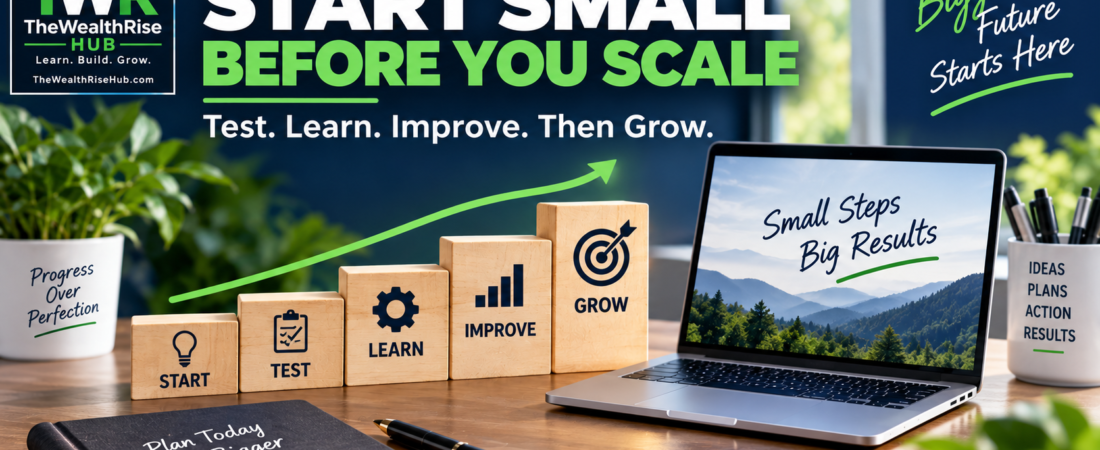
Start → Test → Learn → Improve → Grow
Don’t Confuse Scaling With Success
It’s easy to think that a bigger operation automatically means a more successful business.
It doesn’t.
Adding more advertising, software, products, or expenses before you’ve established what works can simply make an inefficient business more expensive.
Before scaling, ask yourself:
- Is there genuine interest in what I’m offering?
- Do I understand how I’m reaching potential customers?
- Are my basic systems working?
- What is producing the best results?
- What problem am I trying to solve by scaling?
Growth should have a reason behind it.
Use Technology as You Grow
AI and automation can make it easier to manage an online business, but you don’t necessarily need every tool from day one.
Start by identifying repetitive tasks that are taking up your time.
As the business grows, you might use technology to help with content planning, scheduling, organization, communication, research, or other routine activities.
The important thing is to add technology because it solves a real problem, not simply because a new tool is available.
Watch: Start Small Before You Scale
This short video explains why starting small can give you room to learn, make adjustments, and discover what works before committing more time and resources.
Build With the Long Term in Mind
Starting small doesn’t mean thinking small.
It means giving yourself time to understand what you’re building.
You can learn from your audience, improve your approach, develop better systems, and make more informed decisions about where to invest your time and resources.
Then, when you find something that’s working, you have a stronger foundation for growth.
You don’t have to build everything today. Start with something manageable, learn from it, and take the next step when you’re ready.
Visit The WealthRise Hub — Learn. Build. Grow.
Free Online Income Starter Guide
Not sure where to begin? Download our free starter guide for practical guidance on exploring online income opportunities, evaluating your options, and choosing a realistic first step.